
Our world needs more scientists. They work to solve major challenges like climate change, unlock mysteries of the natural world, and explore safer ways to use essential chemicals in everyday products.
This is why teaching scientific literacy at an early age is so important. It instils children with an intimate understanding of the world around them while sparking a curiosity to look deeper.
Primary school teachers use technology and online resources to bring scientific concepts to life. They also use proven teaching methods that support active learning, classroom discussion, and problem-solving.
But there’s an obstacle many educators face – they’re trained in teaching, not science. Fortunately, the national primary science curriculum sets a framework for teaching basic scientific concepts and their importance in everyday life.
In this post:
Key Takeaways
The national science curriculum provides a framework for teaching key concepts and fostering curiosity for natural phenomena
The national curriculum defines core scientific topics for Key Stage 1 (KS1) and Key Stage 2 (KS2), including guidelines for “working scientifically”
Simple classroom activities and experiments help students think independently and relate scientific concepts to daily life
KS2 topics build on the knowledge gained in KS1 and help students apply basic principles of the scientific method
Successful teaching in KS1 and KS2 provides students with practical skills and a deeper understanding of the role science plays in our world
What is the National Primary Science Curriculum?
The national science curriculum helps children develop a curiosity about natural phenomena, understand basic scientific principles, and recognise the role science plays in the natural and man-made world.

Areas of focus include:
- Biology – How living organisms grow, survive, and function in their environment
- Chemistry – How substances like solvents behave and how they’re used in daily life
- Physics – How physical objects and systems move and interact
- Working scientifically – The ability to ask scientific questions, make observations, conduct tests, record data, and interpret results
The curriculum follows a structured progression so students grasp key concepts before moving to more complex ideas.
Language, Maths, and Working Scientifically
Language development is vital across the entire primary school curriculum, including science. Hearing scientific vocabulary used correctly helps students build communication skills and deepen their scientific knowledge.
The primary science curriculum also emphasises the need for students to apply mathematical principles to their learning, specifically when gathering and analysing data. This is part of the “working scientifically” component of the curriculum, which teaches key steps in scientific enquiry, including:
- Asking questions
- Carrying out investigations
- Identifying patterns
- Recording results
- Drawing conclusions
- Presenting ideas
These skills should be taught alongside scientific concepts rather than as a separate programme. The goal is to develop students’ ability to work scientifically during KS1 and KS2 so they’re able to build on these practical skills in high school.
KS1 Science Curriculum Overview
The primary science curriculum for KS1 (ages 5-7) provides children with an understanding of basic scientific concepts. It encourages curiosity, questioning, investigation, and the communication of discoveries.

At this stage, teachers should help students form associations between scientific concepts and daily life. It’s also important for teachers to help students understand scientific terminology.
Core Topics Taught in KS1
The topics taught in KS1 focus on the natural world. The national primary science curriculum breaks learning into five core topics:
- Plants – Identifying common plants and trees, gaining a basic understanding of the structural makeup of plants, and learning how they grow and survive.
- Animals, including humans – Identifying and describing common animals, including mammals, reptiles, birds, fish, and amphibians. This topic also includes identifying basic human body parts and understanding how each part relates to the five senses.
- Living things and their habitats – Identifying whether things are alive, dead, or never living. Students must also learn about simple natural habitats and food chains./li>
- Everyday materials – Identifying and naming everyday materials, like wood, glass, and metal. Students must also learn how to distinguish between an object and the material it’s made of.
- Seasonal changes – Understanding how the weather changes during each season and how day length varies.
As students move through each core topic, teachers should help them carry out simple comparative tests and use secondary sources to make new discoveries.
Age-Appropriate Science Activities
Hands-on learning is crucial in KS1. It develops problem-solving skills and turns scientific concepts into real-life experiences. Teachers can facilitate this through engaging activities that incorporate the core topics outlined in the primary science curriculum.
Here are some stimulating KS1 science activities:
- Bug hunt – Students explore the school grounds to find and identify insects. They can examine different plants and flowers while they’re at it.
- Classroom lava lamps – Mixing water, oil, food colouring, and an effervescent tablet creates a vibrant chemical reaction.
- Mini parachutes – Making simple parachutes out of plastic bags and string demonstrates how gravity and resistance work.
- Water xylophone – Students fill glass cups with different levels of water and tap them with metal spoons to see how vibrations affect sound.
These activities demonstrate the impact science has on the physical world. They’re simple to organise and require minimal supplies, allowing teachers to concentrate on the overarching lesson.
KS2 Science Curriculum Overview
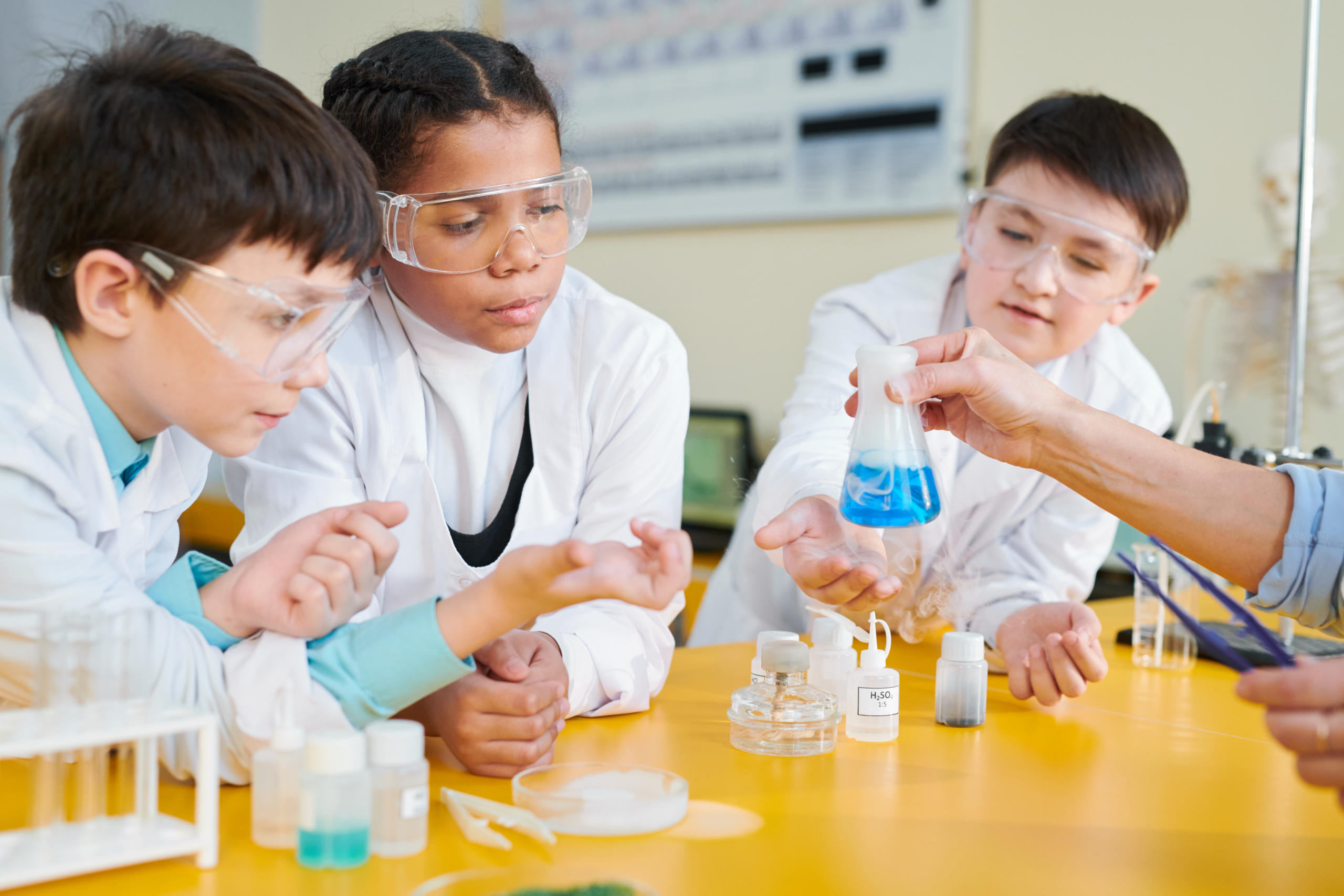
The KS2 (ages 7–11) science curriculum builds on KS1 by developing independent thinking, observation skills, and scientific interpretation. It also introduces more complex subjects not covered in KS1.
Core Topics Taught in KS2
Schools often break KS2 into two sections, lower KS2 (years 3 and 4) and upper KS2 (years 5 and 6). Topics taught in these stages still fall under the core categories of the primary science curriculum.
In addition to expanding their knowledge of plants, animals, habitats, and everyday materials, lower KS2 students study:
- Rocks – Identifying and grouping rocks based on appearance and learning about fossil formation
- Light – Understanding the function of light, recognising the dangers of sunlight, and learning how shadows are formed
- Forces and magnets – Comparing how objects move across different surfaces and learning the principles of magnetism
- States of matter – Understanding how solids, liquids, and gases react to temperature changes
- Sound – Learning about pitch, volume, and how sound travels over distances
- Electricity – Exploring the role of electricity in everyday life and learning how simple circuits work
Students in upper KS2 continue to develop their knowledge of these topics. They also learn more advanced concepts, including:
- Material properties – Grouping everyday materials based on hardness, solubility, and conductivity
- Earth and space – Learning how the Earth moves in relation to the moon, sun, and planets within our solar system
- Evolution – Recognising how life on earth has changed over time and identifying how plants and animals adapt to their environment
Teachers should support KS2 students by conducting simple scientific experiments, teaching more complex data-recording skills, and using modelling alongside lessons on space.
Progression of Knowledge and Vocabulary
Vocabulary becomes more complex in KS2. Students learn terms that help them make scientific observations and interpret information. Examples include “ecosystem,” “hypothesis,” “pollination,” and “translucent.”
Teachers should help students use this vocabulary to explain scientific concepts, describe patterns, and link new knowledge with information learned in KS1. This helps students understand concepts and communicate scientific ideas clearly.
Working Scientifically in KS2
The national primary science curriculum requires KS2 students to progress from making observations to using basic principles of the scientific method.
This involves:
- Fair testing – Students must learn to ask questions, predict outcomes, and perform scientific investigations.
- Measuring and recording – Students use simple equipment like thermometers and microscopes to analyse test results and record their findings.
- Interpretation and communication – Students learn to evaluate test results, draw conclusions, and communicate their findings in oral or written reports.
Teachers should support students by showing them how to use equipment, demonstrating data-recording methods, and encouraging them to connect findings with their scientific knowledge.
Making Science Practical and Engaging
Successful teaching requires more than conveying information and ideas. It’s about helping students form a concrete relationship between scientific concepts and daily life.
Teachers should provide hands-on support while encouraging independent thinking and enquiry. Strategies include:
- Conducting teacher-led scientific experiments and demonstrations
- Explaining the real-life applications of scientific concepts
- Encouraging outdoor exploration in and out of school
- Creating an environment where students feel free to discuss ideas
- Providing visual aids and written prompts to help students get started on their own experiments
- Splitting students into small groups to promote collaborative thinking and further develop their social skills
- Linking scientific concepts to other topics like literature and maths
Using these techniques makes science more relatable to young minds. This fosters a long-term interest in science, develops critical thinking skills, and encourages children to continue exploring the subject in high school and beyond.
Conclusion
When delivered effectively, primary science education builds the foundation for critical thinking, problem-solving, and future scientific learning. By combining hands-on activities with a clear progression from KS1 to KS2, teachers can help students understand how science connects to everything around them.